
Five Years On from the Landmark BS 8414 Test
Five years have passed since MPA Precast completed the landmark BS 8414 fire test at the Fire Protection Association (FPA) testing rigs in Gloucestershire. The test results were categorical, demonstrating the superior performance of precast concrete cladding and providing essential reassurance to the construction industry in the wake of the Grenfell Tower tragedy. As the regulatory landscape continues to evolve—with the publication of the Grenfell Tower Inquiry Phase 2 report and the implementation of the Building Safety Act 2022—the case for non-combustible building materials has never been stronger.
This article reflects on the findings of that pivotal test, the current state of UK building safety regulations, and the inherent, life-saving properties of concrete façades.
The Regulatory Context: A Demand for Intrinsic Resilience
The tragic fire at Grenfell Tower in 2017 fundamentally altered the UK’s approach to building safety. The disaster, which claimed 72 lives, highlighted systemic failures in the specification, testing, and approval of combustible cladding materials [1]. The subsequent Grenfell Tower Inquiry Phase 2 report, published in September 2024, underscored the “systematic dishonesty” of certain cladding manufacturers and the “seriously defective” regulatory framework [2].
In response, the UK government has implemented stringent reforms. The Building Safety Act 2022 established the Building Safety Regulator and introduced a rigorous new regime for “higher-risk” buildings (those over 18 metres or seven storeys) [3]. Furthermore, amendments to Approved Document B have banned the use of combustible materials on the external walls of new buildings over 18 metres in height, including hotels and hostels, and have introduced strict limits for residential buildings between 11 and 18 metres [4].
Despite these measures, the RISC Authority has warned that the current regulatory focus on “evacuation before collapse” can lead to “designs with little intrinsic resilience yet are legal and compliant” [5]. This highlights the urgent need for construction materials that not only meet regulatory minimums but also actively protect property and prevent the spread of fire.
The MPA Precast BS 8414 Fire Test: A Demonstration of Safety
Concrete possesses the highest possible A1 reaction-to-fire classification (in accordance with BS EN 13501-1:2018), meaning it is entirely non-combustible [5]. The full findings are set out in the MPA Precast report, The Non-Combustibility of Concrete Facades, which is available to download. Because of this inherent property, large-scale fire tests on concrete façades are not typically required for building certification. However, to provide absolute confidence to the market, MPA Precast commissioned the FPA to conduct a full-scale BS 8414-2:2020 test on a single-skin precast concrete cladding system in August 2021 [5]. A video summarising the test and its findings is available to watch here.
The test subjected the cladding to a severe fire source, mimicking a post-flashover room fire venting through a window. The results were unequivocal:
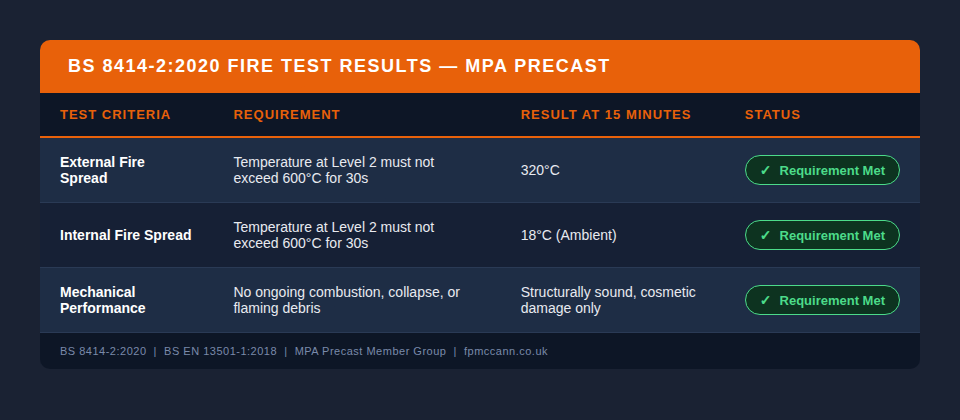
Crucially, 15 minutes into the test, while the external temperature reached 320°C, the temperature behind the panels remained at a cool 18°C [5]. The concrete acted as a highly effective heat shield, preventing the spread of fire into the cavity or insulation layers. Once the fire was extinguished, the panels required only minimal remedial work to restore the building to working order [6].
Real-Life Fire Testing: FP McCann’s Sandwich Panels
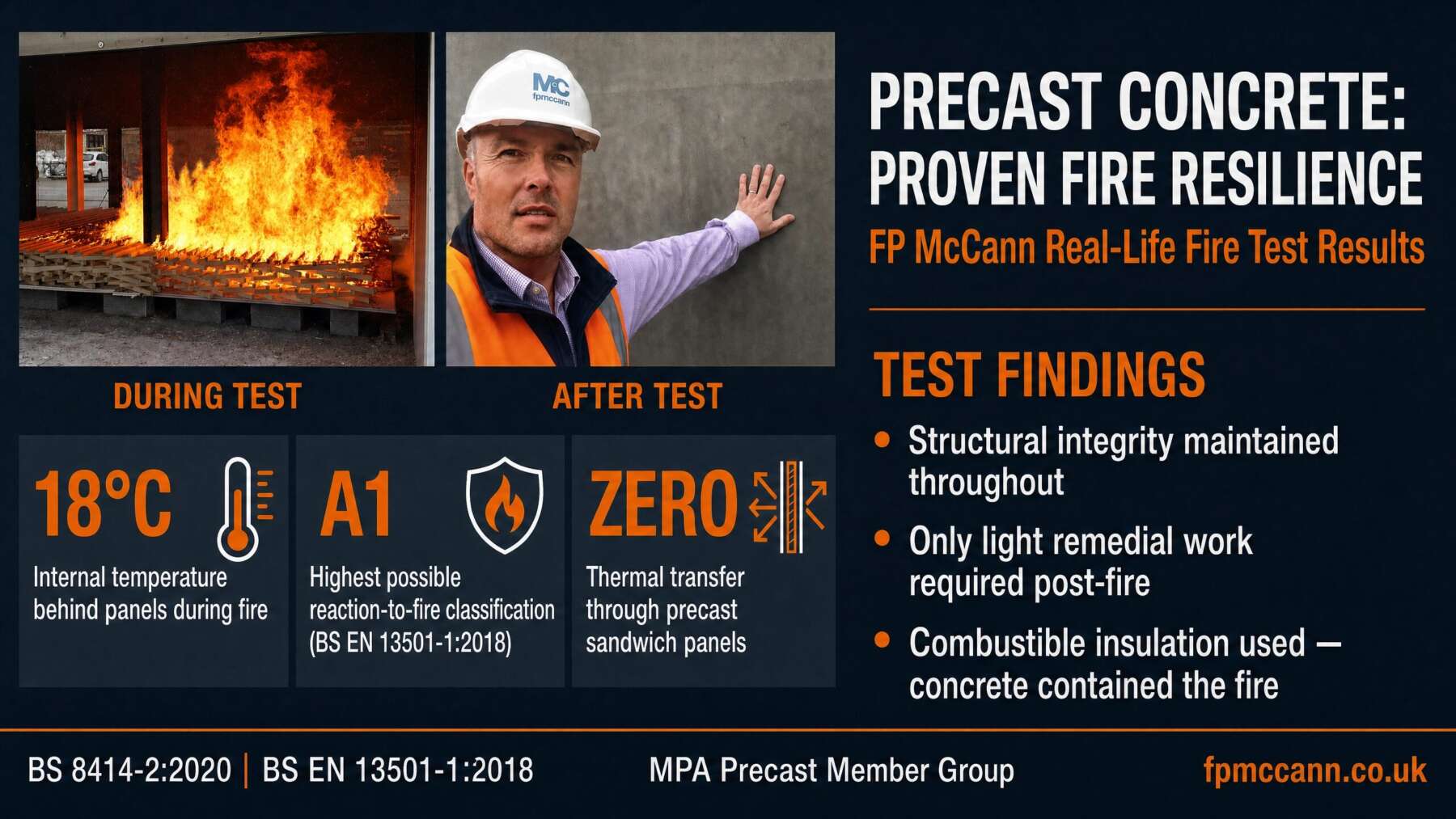
The resilience demonstrated in the FPA laboratory is consistently replicated in real-world scenarios. FP McCann, the UK’s largest precast manufacturer, has conducted extensive real-life fire testing on their precast sandwich panels.
A short video documenting these tests shows that even when combustible insulation is used in the sandwich panel’s core, the precast concrete exterior maintains its structural integrity throughout the fire [7]. The tests revealed zero thermal transfer through the panels, and, as with the MPA Precast test, only light remedial work was required post-fire [7]. This provides further, practical evidence that concrete façades offer robust protection, containing fires and preventing catastrophic structural failure.
“The results of our real-life fire tests speak for themselves. Even with combustible insulation within the panel core, the precast concrete façade maintained its full structural integrity throughout — and there was zero thermal transfer outside the compartment. You could place your hand on the outer face of the panel immediately after the test. That is the kind of inherent, passive fire protection that gives building owners, occupants, and insurers genuine peace of mind. Five years on from the MPA Precast BS 8414 test, the evidence only continues to grow stronger.”
— Kieran Fields, Director of Business Development & Marketing, FP McCann
Beyond Fire: The Multifaceted Benefits of Concrete
The selection of concrete for building façades offers benefits that extend well beyond fire safety. As climate change intensifies, bringing hotter summers and more extreme weather events, building resilience is paramount.
Concrete’s high thermal mass makes it an excellent material for cooling buildings, particularly in hot weather. By absorbing heat during the day and releasing it slowly at night, concrete helps regulate indoor temperatures, reducing reliance on energy-intensive air conditioning systems. This energy efficiency is a vital consideration for sustainable construction in the future.
Furthermore, concrete is inherently water-resistant, providing built-in flood resilience [5]. Its longevity supports whole-life thinking and the circular economy, allowing buildings to be repurposed and their useful lifespans extended [5].
Conclusion
Five years on from the MPA Precast BS 8414 test, the evidence remains clear: concrete is a low-risk, highly resilient solution that saves lives and protects property. As the construction industry continues to navigate the post-Grenfell regulatory environment, specifying non-combustible, A1-rated materials like precast concrete is not just a matter of compliance; it is a responsible design decision that ensures peace of mind for occupants, owners, and insurers alike.
References
[1] 7 Years After the Grenfell Disaster: How Has Fire Safety Changed?
[2] Grenfell Report: Key findings from the inquiry – BBC
[3] Grenfell Tower Inquiry Phase 2 Report: Government response
[4] Combustible materials: new regulations extend ban
[5] The Non-Combustibility of Concrete Facades — MPA Precast / UK Concrete (PDF)
[6] Fire and resilience – MPA Precast
[7] FP McCann Real Life Fire Testing on Precast Sandwich Panels – YouTube