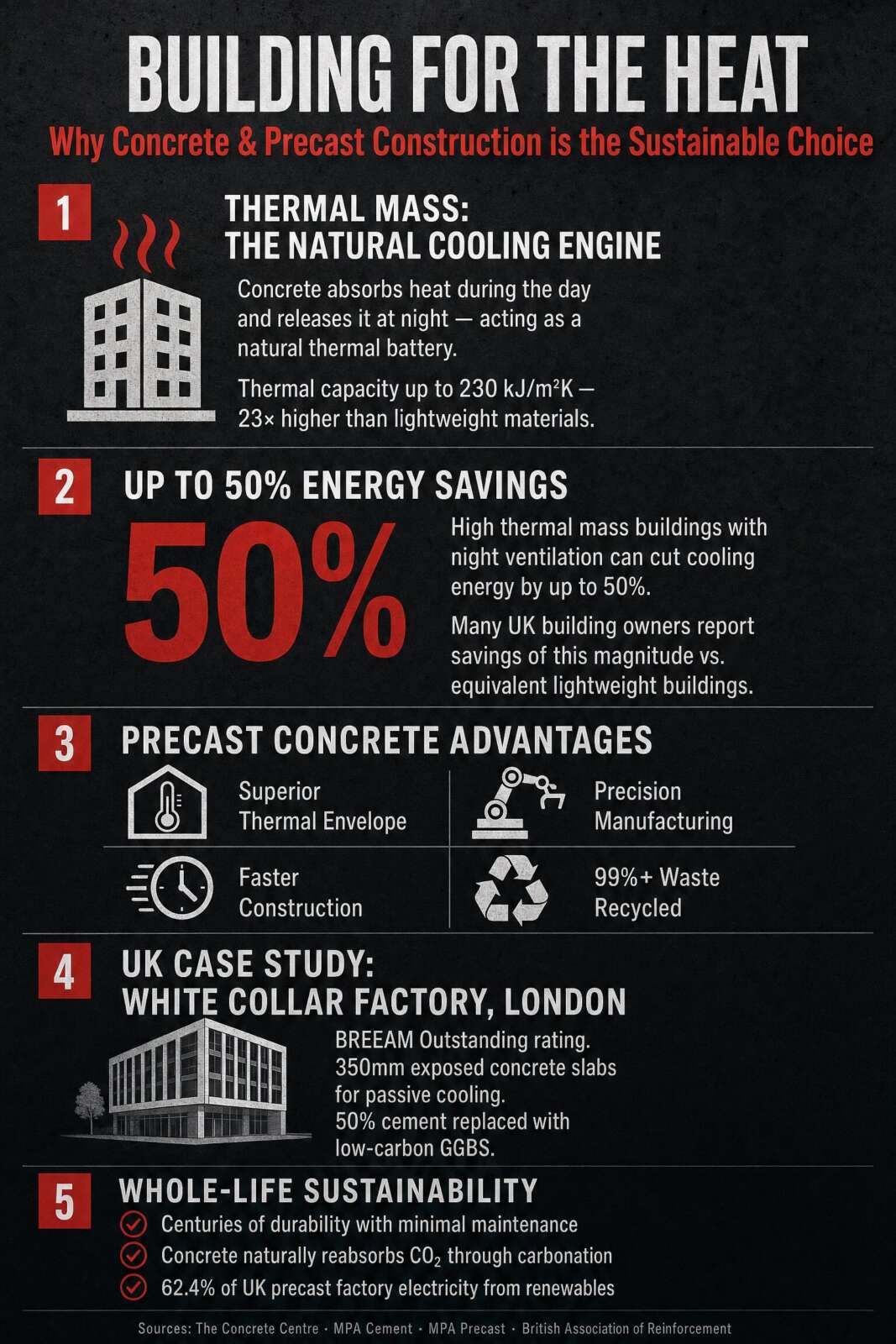
Why Concrete and Precast Construction is the Sustainable Choice
As the UK experiences increasingly intense and frequent heatwaves, the vulnerability of our built environment is becoming starkly apparent. The record-breaking temperatures of recent summers, including the unprecedented 40.3°C in 2022, have exposed the flaws of relying heavily on lightweight construction materials such as timber and steel [1]. These materials offer little resistance to soaring temperatures, turning buildings into greenhouses and driving up the demand for energy-intensive air conditioning.
However, there is a proven, sustainable, and highly effective alternative: building with concrete, particularly precast concrete. The inherent properties of concrete offer significant benefits for regulating indoor temperatures, slashing energy consumption, and contributing to a more sustainable, low-carbon future.
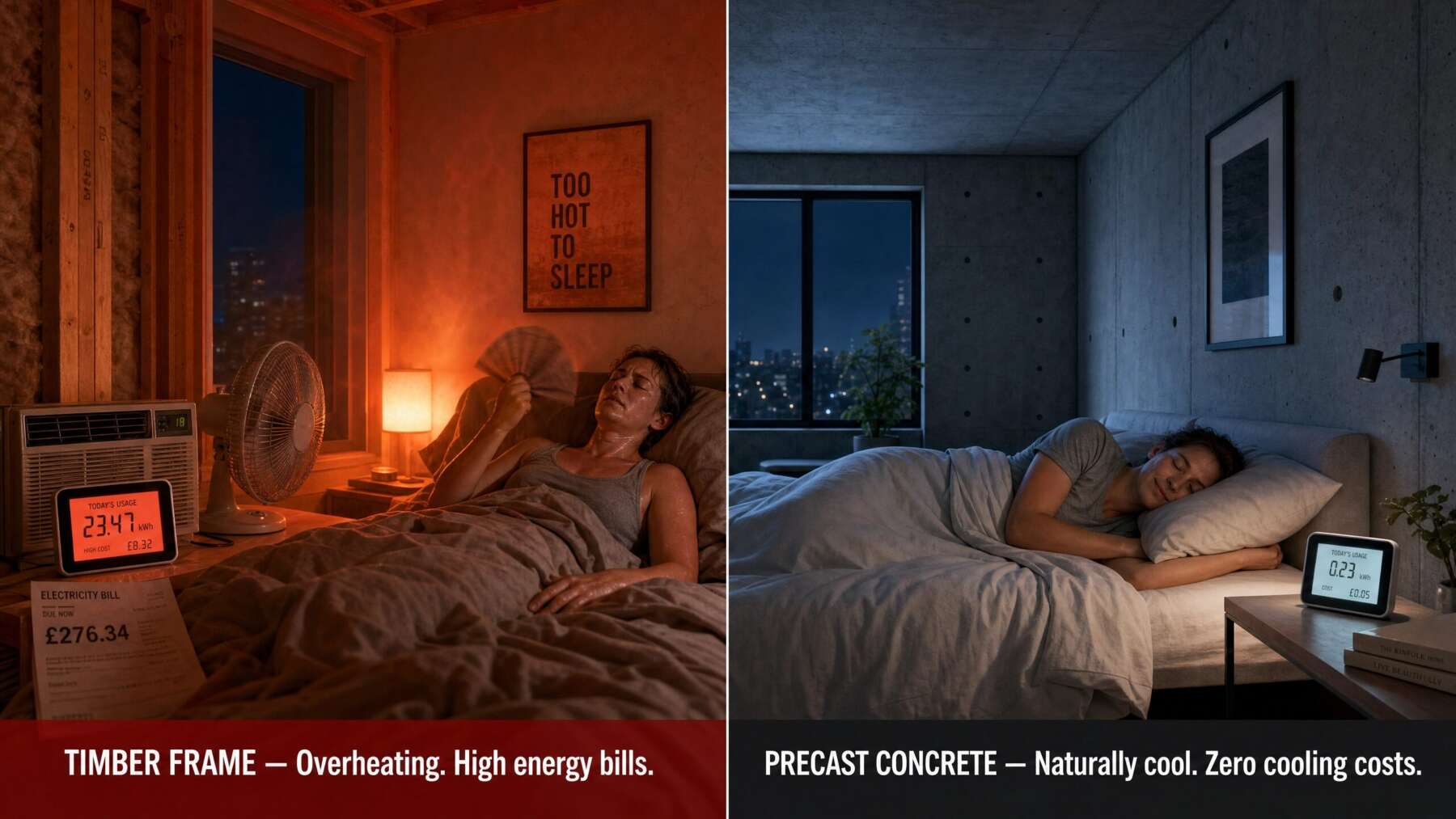
The Power of Thermal Mass: Passive Cooling in Action
The key to concrete’s ability to combat extreme heat lies in its high thermal mass. Thermal mass refers to a material’s capacity to absorb, store, and slowly release heat energy [2]. Heavyweight materials like concrete and masonry excel in this regard, whereas lightweight alternatives do not.
During a hot summer day, exposed concrete surfaces within a building (such as floors or ceilings) absorb excess heat from the air, sunlight, and internal sources like computers and people [3]. This absorption prevents the indoor temperature from rising rapidly, keeping the environment cooler and more comfortable. This process is known as passive cooling.
At night, when outside temperatures drop, the building can be ventilated with cooler air. The concrete then releases the stored heat, effectively “purging” it from the building and resetting the thermal mass for the next day [2]. This natural cycle acts as a thermal battery, smoothing out temperature fluctuations and significantly reducing the risk of overheating.
Real-World Energy Savings
The impact of thermal mass on energy consumption is profound. By relying on passive cooling, buildings can drastically reduce or even eliminate the need for mechanical air conditioning.
Research indicates that high-thermal-mass office buildings, when coupled with effective night-time ventilation, can reduce the energy required for cooling by up to 50% [3]. Given that heating and cooling account for a substantial portion of a building’s operational carbon emissions, this translates to massive energy and cost savings over the structure’s lifetime.
A prime UK example is the White Collar Factory in London. This landmark office building features exposed 350mm reinforced concrete flat slabs. The substantial thickness was chosen specifically to provide the necessary thermal mass to keep the building cool in summer and warm in winter [4]. Passive cooling is further enhanced by water pipes embedded in the slabs, which are controlled by an advanced building management system. This innovative use of concrete contributed to the building achieving an “Outstanding” BREEAM rating [4].
Furthermore, a life cycle carbon analysis by MPA The Concrete Centre compared a six-storey concrete residential building with an equivalent cross-laminated timber (CLT) structure. The study found that the concrete apartments could remain comfortably cool, primarily through exposed thermal mass and night cooling, with only low-energy ceiling fans needed. In contrast, the lightweight CLT building required active air conditioning from the outset [1]. The concrete apartments also demonstrated an average peak space-heating demand approximately 25% lower than that of the CLT option [1].
The Advantages of Precast Construction
While in-situ concrete offers excellent thermal mass, precast concrete elevates the benefits of concrete construction by adding efficiency, precision, and further sustainability advantages. Precast concrete components are manufactured off-site in controlled factory environments before being transported and assembled on-site.
1. Built-In Energy Efficiency
Precast concrete panels, particularly insulated sandwich panels, provide a complete, highly efficient building envelope. These panels integrate insulation between layers of concrete, eliminating thermal bridges and ensuring exceptional airtightness. This tight envelope works in tandem with the concrete’s thermal mass to lock in cool air during summer and retain heat during winter, further driving down HVAC (Heating, Ventilation, and Air Conditioning) costs.
2. Reduced Waste and Circularity
The controlled factory environment of precast manufacturing minimises waste significantly compared to on-site pouring. Materials are precisely measured, and any leftover concrete or water can often be recycled back into the production process [5]. According to the MPA Precast and Masonry Sustainability Report 2024, over 99% of all precast and masonry manufacturing waste is reused or recycled [6]. This aligns perfectly with the principles of a circular economy.
3. Quality and Speed of Construction
Precast elements are manufactured to exacting standards, ensuring consistent high quality and structural integrity. Because the components are made concurrently with site preparation, construction timelines are drastically reduced. This speed not only saves money but also minimises disruption and local air pollution at the building site.
A Holistic Approach to Sustainability
The benefits of concrete extend beyond thermal mass and energy savings. When evaluating the sustainability of building materials, it is crucial to consider the whole-life carbon impact, not just the embodied carbon from initial manufacturing.
- Durability and Longevity: Concrete structures are incredibly robust and can last for centuries with minimal maintenance. This long lifespan means fewer resources are needed for repairs or replacements over time.
- Adaptability: Concrete-framed buildings can often be easily repurposed or retrofitted, extending their useful life and avoiding the environmental cost of demolition and rebuilding [7].
- Carbonation: Throughout its life, concrete naturally absorbs CO2 from the atmosphere in a process called carbonation. This process continues even after the building is demolished, if the concrete is crushed and recycled, allowing it to reabsorb a significant portion of its original embodied carbon [7].
- Decarbonisation Efforts: The UK precast industry is actively working to reduce its embodied carbon. The use of low-carbon cementitious materials (like Ground Granulated Blast-furnace Slag or Fly Ash) is increasing. In 2023, the savings associated with the embodied carbon of cement used in structural precast products reached 76 kg CO₂e/m³ compared to 2016 levels [6].
Conclusion
As the UK grapples with the realities of a changing climate and the urgent need to decarbonise our built environment, a rethink of our construction methods is essential. Lightweight materials may offer short-term construction speed, but they often lead to long-term operational inefficiencies and overheating risks.
Concrete, and specifically precast concrete, provides a robust, sustainable solution. By harnessing the power of thermal mass, we can create buildings that naturally resist the summer heat, drastically cut energy consumption, and provide safe, comfortable environments for generations to come. It is time to build with the future in mind, and that future is built on the solid foundation of concrete.
References
[1] British Association of Reinforcement. “HEATING UP UK NEEDS HEAVYWEIGHT BUILDING RETHINK”. Available at: https://www.uk-bar.org/news/HEATING-UP-UK-NEEDS-HEAVYWEIGHT-BUILDING-RETHINK/132049
[2] The Concrete Centre. “Thermal mass”. Available at: https://www.concretecentre.com/Performance-Sustainability/Thermal-Mass.aspx
[3] MPA Cement. “Thermal Mass”. Available at: https://cement.mineralproducts.org/MPACement/media/Cement/Publications/2023/UK-Concrete-Thermal-Mass-lever-paper.pdf
[4] The Concrete Centre. “White Collar Factory, London”. Available at: https://www.concretecentre.com/Case-Studies/White-Collar-Factory,-London.aspx
[5] Structurama. “The Environmental Benefits of Using Precast Concrete”. Available at: https://www.structurama.com/blog/the-environmental-benefits-of-using-precast-concrete/
[6] MPA Precast. “Precast Concrete and Masonry Sustainability Report 2024”. Available at: https://www.mpaprecast.org/getattachment/Homepage/Precast-Masonry-Sustainability-Report-2024-DIGITAL.pdf.aspx?lang=en-GB
[7] UK Concrete. “Five ways concrete is creating lower-carbon buildings”. Available at: https://www.thisisukconcrete.co.uk/Tackling-climate-change/Five-ways-concrete-is-creating-lower-carbon-buildi.aspx